
When it comes to starting a woodworking business, there are a lot of things you need to do! Use this free printable woodworking business start-up checklist to get your business off to a great start!
You can download the free PDF printable of this business startup checklist at the bottom of this page!

Steps to Starting Your Woodworking Business
Below is the list of everything you need to do when starting your woodworking business.
Step 1: Create a Business Plan
- Choose Your Business’s Legal Structure (Individual Proprietor, Partnership, LLC, etc.)
- Name Your Business
- Write Your Mission Statement
- Write Your Elevator Pitch
- Define Your Niche
- Research Your Target Market
- Research Your Competition
- Decide What Products to Sell
- Determine What Price to Set For Your Products
- Estimate Start-Up Costs
- Set Measurable Goals
Step 2: Setup Your Business
- Meet With Small Business Attorney and Accountant
- Register Your Business Name
- Apply for EIN#/Tax-Exempt ID
- Apply for Necessary Permits/Licenses
- Open a Business Checking Account
- Create a Stripe/Paypal Account
- Choose Your Online Shop Platform
- Purchase Small Business Insurance
- Setup Accounting Software and System for Keeping Records
Step 3: Setting Up Your Workspace
- Organize Your Workshop Space
- Organize a Shipping Area
- Create a System for Managing Inventory
- Organize Your Office Space
- Order Necessary Supplies and Materials for Products
- Order Packaging and Shipping Supplies
Step 4: Create Your Online Web Presence
- Register Domain for Your Business Website
- Purchase Hosting For Your Website
- Create Social Media Accounts – Facebook, Pinterest, Instagram, YouTube, etc.
- Design Your Logo or Hire a Graphic Designer
- Setup Your Website and Blog or Hire a Web Developer
- Setup Your Online Shop
- Setup Business Email
- Create & Build Email Mailing List
Step 5: Selling Your Products
- Make Products
- Photograph Products
- Research Product Keywords
- Write Detailed Product Descriptions
- List Products for Sale in Your Shop
Step 6: Marketing Your Business
- Create a marketing plan
- Schedule Your Newsletters
- Create & Order Business Cards
- Post to Social Media Channels
- Notify Your Circle of Influence
- Join Networking Groups
- Create a Blog Posting Schedule
While it may seem overwhelming to start a woodworking business, this checklist will help make sure you stay focused and on-task!
What each step involves
The checklist above is the short version. Here is what each stage actually involves, in the order that saves you money, with the tools on this site that help.
Step 1: the plan is mostly arithmetic
A woodworking business plan does not need to be long, but it does need three numbers: what one piece costs you to make, what you can sell it for, and how many you can make in a month. Work them out for your first two or three products before you register anything. Our woodworking pricing calculator and lumber cost calculator do the sums.
Worked example: a cutting board uses $14 of hardwood, $2 of finish and hardware, and 2.5 hours of shop time. At $25 an hour for your labour that is $62.50, so the cost of the board is $78.50 before overhead. Add 15% for overhead (blades, sandpaper, electricity, fees) and the break-even price is about $90. If boards like yours sell for $60 in your market, the plan has told you something important: batch the work down to an hour per board, or make a different product. These figures are an example, not a market price; use your own.
Step 2: registration and tax, in a sensible order
- Structure first: a sole proprietorship needs no formation filing in most US states (though trading under a name other than your own usually needs a DBA registration); an LLC is filed with your state’s business registry. An accountant can tell you which fits your situation.
- Name: check it is free before you print anything (see our business name guide for how).
- EIN: in the US the IRS issues an Employer Identification Number free of charge on irs.gov. Be wary of sites that charge for it.
- Sales tax: most US states require a seller’s permit before you sell taxable goods, including at craft fairs. Your state revenue department’s website lists the rules.
- Separate bank account and insurance: keeping business money separate makes bookkeeping and taxes far easier. Ask an insurer about product liability cover if you sell items such as toys, furniture or cutting boards.
Step 3: the workspace
Set the shop up around the products you chose in step 1. Plan dust collection and safe storage before buying more machines (see our woodworking safety tips), and set aside a clean, dust-free area for finishing and packing so finished pieces do not pick up dust.
Steps 4 to 6: selling and marketing
Photograph pieces in daylight against a plain background, and write descriptions that state the wood species, the finish and the exact dimensions; buyers ask about all three. Our wood species database has hardness and stability figures you can quote accurately. For promotion ideas, see 59 marketing ideas for your woodworking business, and for what sells, the most profitable woodworking projects.
This checklist is general information, not legal or tax advice. Rules differ by state and country, so confirm the registration and tax steps with your local authorities or an accountant.
Download the Free Printable Checklist!
Here is a preview of what the printable woodworking business checklist looks like. You can see I also added a space for you to add your own to-do list items.
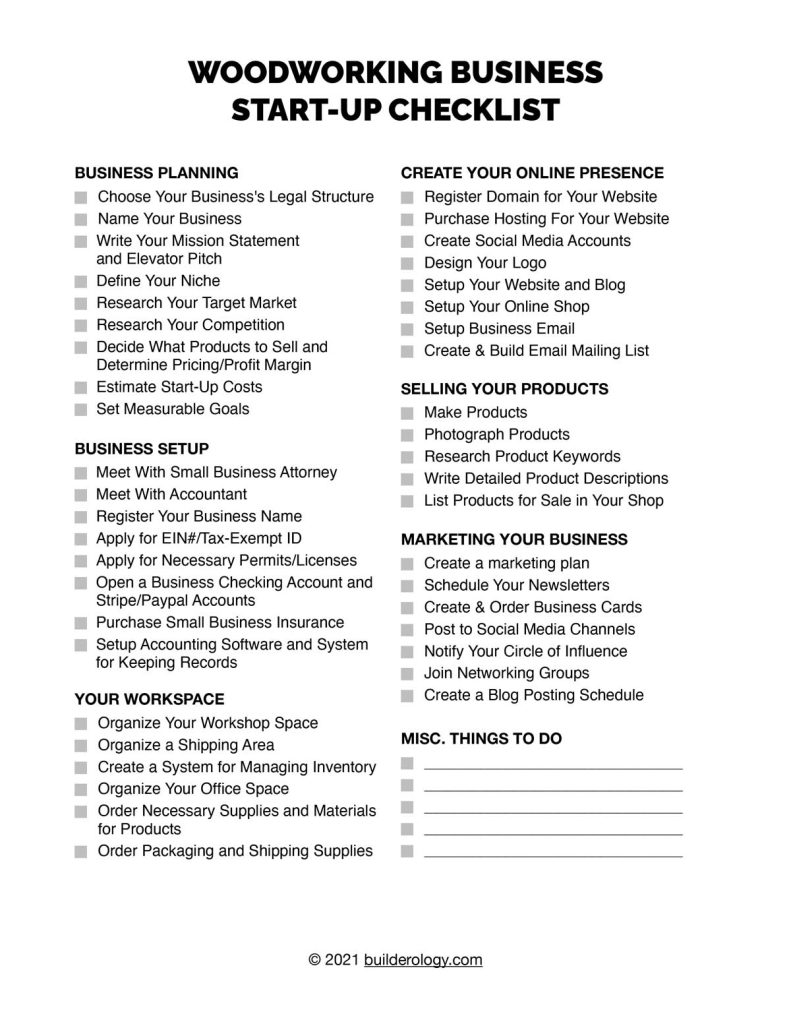
There is no sign-up necessary to download the free checklist – just click on the download link below to download the file!
Click Here to Download the Free Printable Woodworking Business Checklist PDF
Looking for more great resources for starting your woodworking business? Check out these other posts on our website:
- Woodworking Business Name Ideas
- Most Profitable Woodworking Projects to Make and Sell
- 15 Woodworking Business Opportunities
- 59 Marketing Ideas for Your Woodworking Business
I hope this business start-up checklist is helpful for you in starting your woodworking business – Tell me about your woodworking business plan in the comments section below!